Who counts as a Tier-1 retailer, what FBR POS integration requires, what non-compliance can cost, and how to get connected and stay connected.
If you run a chain store, a large shop or a retail outlet in Pakistan, there is a good chance FBR requires your point-of-sale system to report each sale in real time. Many retailers still aren't sure whether this applies to them. Others connected once and don't realise they have since dropped offline. Here's how to work out where you stand.
What is FBR POS integration?
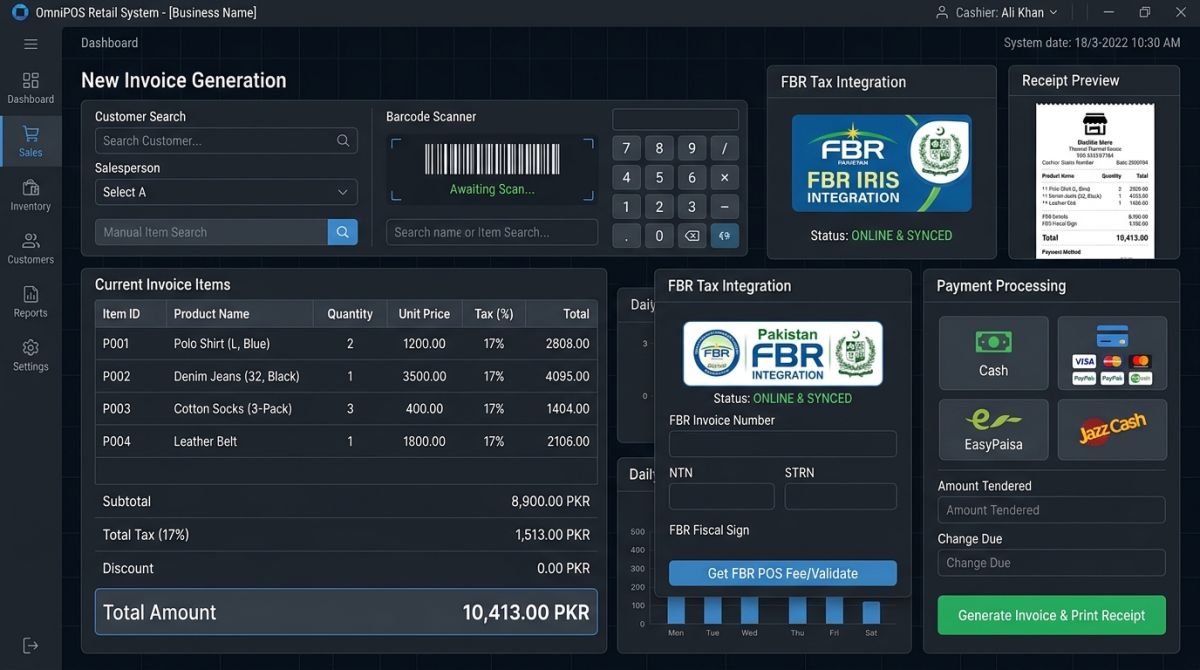
A POS system connected to FBR sends each sale to FBR's computerised system as it happens. FBR returns an invoice number, and the POS prints it on the receipt along with a QR code. Customers can scan that code with an FBR-linked app such as Tax Asaan to check that the invoice is genuine.
The requirement comes from section 3(9A) of the Sales Tax Act, 1990, which obliges Tier-1 retailers to integrate their outlets with FBR for real-time reporting.
Are you a Tier-1 retailer?
Tier-1 status is defined in section 2(43A) of the Act. It has several tests, and meeting one can be enough. They include factors such as:
- Being part of a national or international chain of stores
- Operating in an air-conditioned shopping mall or plaza
- The size of your shop, your electricity bills, or your turnover
- Paying withholding tax under section 236H of the Income Tax Ordinance above a set amount; S.R.O. 1842(I)/2023 set this at Rs100,000 over the preceding twelve months
Check the current definition. The tests and thresholds are amended through finance acts. One summary of the 2026 budget describes further changes to sales tax rules, so don't rely on what applied last year. Ask your tax advisor to confirm your status in writing.
The rule isn't limited to clothing brands. The same guide notes that the obligation covers Tier-1 retailers generally, and FBR publishes separate lists for textile and leather retailers and for restaurants.
Why it matters: the cost of not integrating
Consequences can be financial as well as legal. Press reports have said that since June 2024, a Tier-1 retailer that hasn't integrated faces automatic disallowance of input tax when filing its sales tax return. In plain terms, you could end up unable to claim tax you've already paid to your suppliers. On a business with thin margins, that can do more damage than a one-off fine.
Penalties and enforcement steps change over time, so ask your advisor about the current position. There may also be a benefit to compliance: The News reported in 2026 that FBR excluded certain supplies by POS-integrated retailers from retail-price-based taxation.
"Integrated" isn't the same as "connected"
Installing a POS once doesn't finish the job. FBR's list showed 11,376 integrated Tier-1 retailers with 23,784 branches up to 31 March 2026. Yet a February 2026 report by Profit said around 80% of listed branches were marked as disconnected.
Whatever the reasons in individual cases, the lesson is clear: don't assume you're still reporting just because you were set up correctly once. Common causes to check include:
- An expired or changed access token
- Sales sitting unsent after an internet outage
- A new branch or counter that was never registered
- A software update that broke the connection
- Products with missing HS codes, which vendors report can stop an FBR invoice number being generated
How to get integrated
- Confirm your status. Ask your tax advisor whether you are Tier-1, and whether digital invoicing also applies to you. It's a separate requirement.
- Prepare your records. You'll typically need your NTN, branch and outlet details, and information on your POS software.
- Choose your POS. Check that it supports FBR integration properly, and ask to see a real FBR receipt it has produced.
- Register each outlet through FBR's process, and get the POS registration details used on your invoices.
- Clean your product data. Add HS codes, units and tax rates to every item.
- Test a live receipt. Scan the QR code to verify it, and check that the invoice number and tax are correct.
- Train your cashiers, including what to do if a sale doesn't get an FBR number.
If you develop your own POS, our guide to integrating a PHP POS with FBR covers the technical side.
A monthly check that takes ten minutes
- Scan the QR code on a recent receipt from each branch.
- Compare sales totals in your POS against the figures reported to FBR.
- Review any invoices stuck without an FBR number.
- Confirm new counters and branches have been registered.
- Check whether any tax rates have changed.
What to ask a POS vendor
- Can you show me a real FBR-verified receipt from your system?
- What does the system do during an internet outage, and how are unsent sales handled?
- Will it warn me if the FBR connection stops working?
- Can I change tax rates myself?
- Who updates the software when FBR's rules change, and at what cost?
ShahParzSoft's FBR IRIS compatible POS system handles billing, barcode scanning, thermal receipts, inventory and sales reports for retail shops and restaurants. Contact us for a demo, or read our checklist on choosing the right software.
Sources: Baco Consultants: Tier-1 POS integration · FBR: POS integrated retailers · Profit: POS connection report · The News: POS retailers and retail price tax · VATupdate: Finance Bill 2026. This article is general information, not tax advice. Confirm your position with FBR or a qualified tax advisor.