How housing societies can automate electricity billing: meter readings, slab tariffs, surcharges, payment tracking and finding losses between meters.
In many housing societies, plazas and commercial complexes, the monthly electricity billing run still depends on a register, a spreadsheet and a lot of patience. A single wrong reading or tariff slab can trigger complaints, and unpaid bills are easy to lose track of. Billing software will not remove every problem, but it removes most of the manual work where errors creep in.
Where manual billing goes wrong
- Reading and typing errors. Figures are copied from a meter to paper to a spreadsheet, and each copy is a chance for a mistake.
- Slab mistakes. One edited or dragged spreadsheet formula can overcharge a whole block.
- Unclear arrears. Without a proper ledger, it is hard to show a resident what they owe and why.
- Slow reconciliation. Matching bank deposits to individual bills by hand can take days.
- Hidden losses. Nobody notices when the units billed to residents fall well short of the units the society paid for.
What goes into an electricity bill
A bill is more than units multiplied by a rate. Whatever you charge consumers, your system should treat each of these as a separate, configurable line. Never bury them in a single formula.
| Component | How it works |
|---|---|
| Energy charge | Units consumed, priced by slab and consumer category |
| Fixed charges | A monthly amount that does not depend on units. NEPRA introduced fixed charges of Rs200 to Rs675 for most domestic categories in 2026 |
| Fuel adjustment (FPA) | A per-unit charge or credit that changes monthly and can be negative. It usually relates to an earlier month's consumption |
| Quarterly adjustment (QTA) | A periodic per-unit adjustment |
| Electricity duty | A provincial levy |
| Sales tax and other levies | Applied according to current rules, so keep them in editable settings |
| Arrears and late surcharge | Previous balance, plus a penalty after the due date |
These amounts change often, so the business, not a programmer, should be able to update them. Keep a dated history too. An old bill must always show the rates that applied at the time.
Check the legal position first. The rules on supplying and re-billing electricity to end users depend on your connection type and arrangement. Confirm with your DISCO or NEPRA what your society may charge. Software can apply whatever rates you enter, but it cannot tell you which ones you are allowed to apply.
How the automated cycle works
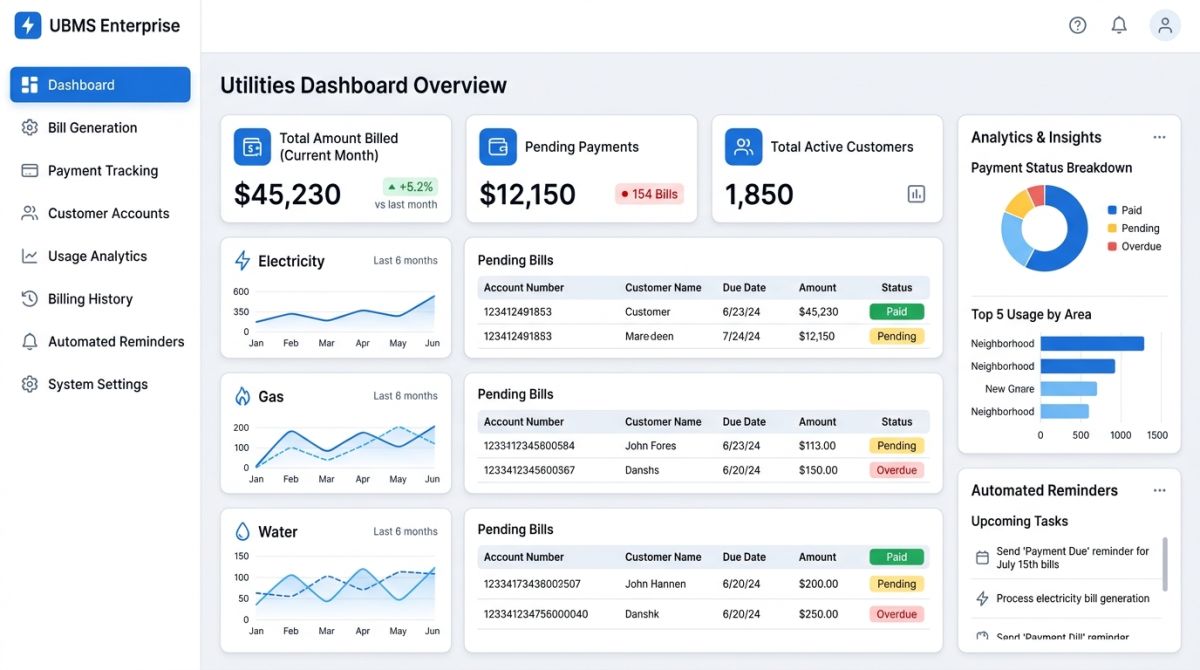
- Reading. Staff enter readings on a phone or tablet at the meter. The system checks them against the last reading and flags anything unusual, such as a lower reading or a sudden jump.
- Calculation. Once readings are approved, every bill is calculated from the same tariff settings.
- Review. A manager sees exceptions, like zero consumption or usage far above the consumer's average, before anything is issued.
- Delivery. Bills are printed or sent as a PDF, with SMS or WhatsApp alerts.
- Payment. Each payment is recorded against its bill, whether by cash, bank or mobile wallet. The consumer's ledger updates instantly.
- Follow-up. Reminders go out automatically, surcharges apply after the due date, and defaulters appear on a report.
Example: one bill, calculated the same way every time
Here is how a system would work through a bill, using made-up rates purely for illustration. Previous reading 12,400 and current reading 12,650 gives 250 units.
| Line | Calculation | Amount (Rs) |
|---|---|---|
| First 100 units | 100 × 20 | 2,000 |
| Next 150 units | 150 × 30 | 4,500 |
| Fixed charge | Set amount | 300 |
| Fuel adjustment | 250 × 1 | 250 |
| Subtotal | 7,050 | |
| Tax | 10% of 7,050 | 705 |
| Total due | 7,755 |
Real tariffs differ, including how slabs apply and which lines are taxed, so your settings must match your actual rates. The advantage is that the same logic runs for all 500 or 5,000 consumers, and any bill can be explained line by line when someone questions it.
Find your line losses
A society with a main bulk meter and individual sub-meters can compare the two totals each month. This report is often the most valuable one in the system.
Loss % = (bulk meter units − total units billed) ÷ bulk meter units × 100
For example, if the main meter records 100,000 units and residents are billed for 92,000, 8% is unaccounted for. Some loss in the wiring is normal. A figure that keeps rising, or one area that stands out, can point to a faulty meter, an unbilled connection or theft. Tracking it by feeder or block shows you where to look.
What to look for in billing software
- Tariffs and charges you can edit without a developer, with a dated history
- Consumer ledgers showing all bills, payments and adjustments
- Validation of readings and an approval step before bills are issued
- An audit log showing who changed a reading or bill, and when
- Bank and mobile wallet reconciliation, plus SMS and WhatsApp alerts
- Reports on collections, defaulters, consumption trends and line loss
- Backups, and the right to export your own data
Moving over without disruption
Don't switch everything in one month. Enter consumers and opening balances, then run one cycle on both the old method and the new system and compare the results. Once they agree, or you can explain every difference, move on. Tell residents about any change in bill layout so they don't mistake it for a change in charges.
ShahParzSoft's electricity billing system is built around this cycle, from meter reading through to payment tracking and usage reports. Ask for a demo using your own tariff and a sample of your consumers.
Sources: Profit: NEPRA fixed charges · NEPRA. Rates and rules change, so confirm current figures with your DISCO or NEPRA.